

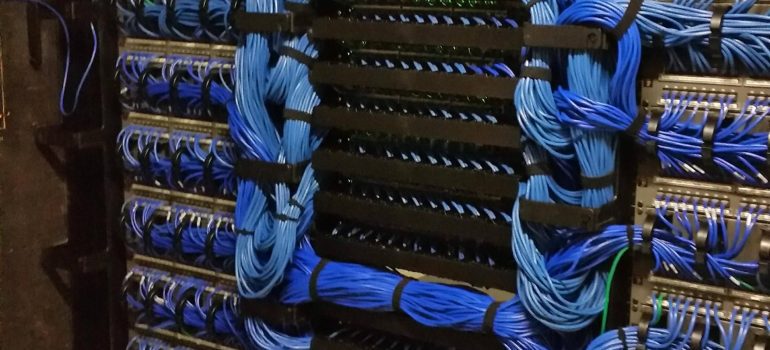
If your office network still slows to a crawl every time your team is on video calls, uploading files, and running cloud apps at the same time, the problem usually isn’t your internet plan — it’s the cabling behind the walls. Structured cabling services for commercial buildings are the foundation that determines whether your Wi-Fi, phones, security cameras, and point-of-sale systems actually work together, or fight each other for bandwidth. For businesses across Ontario, Quebec, Alberta, and British Columbia, getting this right is no longer optional; it’s the backbone of daily operations.
Structured Cabling Services for Commercial Buildings
- Structured cabling organizes all of a building’s data, voice, and video wiring into one standardized, labelled system — reducing downtime and simplifying future upgrades.
- Commercial-grade cabling (Cat6/Cat6a or fibre) supports higher device density, faster speeds, and fewer outages than patchwork wiring left behind by previous tenants.
- Canadian businesses in growing commercial hubs like Toronto, Calgary, and Vancouver benefit most from planning cabling upgrades before a lease renewal or office move, not after problems start.
Ready to fix your office network for good? Call SARSH Solutions at +1 365-866-2628 or visit sarshsolutions.ca to book a site assessment.
What Exactly Is Structured Cabling, and Why Does It Matter?
Structured cabling is the organized system of cables, patch panels, and outlets that carries data, voice, and video traffic throughout a commercial building. Instead of a tangle of mismatched wires added over the years by different vendors, a structured system follows a standardized design — usually built around a main equipment room, horizontal cabling to each workstation, and clearly labelled patch panels.
For growing businesses, this matters because your network is only as reliable as its weakest cable run. A poorly cabled office might handle email fine but choke the moment your team starts video conferencing, backing up files, or running a busy retail POS system during a Saturday rush.
How Much Cabling Capacity Does Your Office Actually Need?
This is one of the most common questions from Ontario and Alberta business owners moving into a new commercial space. The honest answer depends on your headcount, the number of connected devices per desk, and whether you’re running bandwidth-heavy applications like VoIP phones, cloud backups, or security systems on the same network.
A small professional office with a dozen staff has very different needs than a warehouse running inventory scanners and dozens of IoT sensors. That’s why a proper site walkthrough — not a generic template — should always come before ordering cable and equipment.
Cat6, Cat6a, or Fibre: What’s Right for a Commercial Building?
- Cat6 handles most standard office workloads well and remains a cost-effective baseline for smaller commercial spaces.
- Cat6a supports higher speeds over longer distances and is a smart choice for growing teams or buildings with larger floor plans.
- Fibre is increasingly the standard for larger commercial buildings, multi-tenant properties, and businesses that need serious future-proofing, especially where dedicated fibre internet is available.
Check if fibre-ready fibre internet service is available at your commercial address before finalizing a cabling plan — it changes what’s worth installing today versus what to leave flexible for later.
Why Do Commercial Cabling Projects Get More Complicated in Canada?
Canadian commercial buildings bring a few wrinkles that don’t always show up in generic cabling guides. Older buildings in cities like Montreal and Ottawa may have legacy wiring that needs to be fully removed, not just added to. Multi-tenant office towers often require coordination with property management and building codes before any cable run can go through shared risers. And in newer developments across Calgary and Edmonton, the challenge is usually the opposite — making sure the cabling plan supports 3-5 years of growth, not just the day-one headcount.
Winter matters here too. A commercial building that loses network connectivity during a severe prairie or Ontario snowstorm isn’t just an inconvenience — it can mean a full day of remote staff unable to reach shared drives or phone systems if the cabling and network hardware weren’t installed to handle demand spikes.
Comparing Commercial Internet & Cabling Plans
| Plan Type | Recommended Speed | Best For | Price |
|---|---|---|---|
| Basic High-Speed | [100Gbps] | Small offices / browsing & cloud apps | [$65] |
| Family / Remote Work | [150Gbps] | Multi-user offices / remote & hybrid teams | [$85] |
| Gaming / Pro | [200Gbps] | High-density buildings / heavy data use | [$95] |
Not sure which tier fits your building? Call +1 365-866-2628 or reach out via sarshsolutions.ca — our team can map cabling needs to the right internet plan before you sign anything.
Switching to a Better-Cabled Commercial Network in 3 Steps
- Step 1 — Site Assessment: A technician reviews your current cabling, equipment room, and floor plan to identify weak points and outdated wiring.
- Step 2 — Custom Cabling Plan: You get a proposal matched to your headcount, device load, and growth plans — whether that’s Cat6a or full fibre backbone.
- Step 3 — Installation & Testing: Certified installers run and label the cabling, then test every connection before handing off a clean, documented network.
This process applies whether you’re in a Toronto high-rise, a Vancouver retail unit, or a warehouse outside Edmonton — the steps stay the same, even if local building requirements differ.
Structured Cabling Services for Commercial Buildings
Frequently Asked Questions
1. Does structured cabling installation disrupt daily business operations? Most commercial cabling work can be scheduled after hours or in phases specifically to avoid disrupting your team during business hours.
2.Are there hidden fees with commercial cabling projects? Reputable providers walk through equipment, labour, and any building-access costs upfront. Ask for a written scope before work begins to avoid surprise charges partway through.
3.Do you provide structured cabling services outside major cities? Coverage varies by province and building type — confirm availability for your specific address in Ontario, Quebec, Alberta, or BC before planning a project timeline.
4.Do CRTC regulations affect commercial cabling or internet service? CRTC rules primarily govern telecom providers like Bell, Rogers, TELUS, and Videotron rather than in-building cabling itself, but they do shape service transparency and contract terms worth reviewing when you select a provider.
Why SARSH Solutions for Your Commercial Cabling Project
A commercial building’s network is only as strong as the cabling running through its walls. Whether you’re renovating an older office in Montreal, fitting out a new unit in Calgary, or scaling up in a Toronto business park, getting structured cabling right the first time saves you from costly rework, downtime, and frustrated staff down the line. SARSH Solutions works with Canadian businesses to plan and install cabling systems matched to how the building is actually used — not a one-size-fits-all template.
Check if SARSH fibre is available at your commercial address → sarshsolutions.ca
Ready to talk through your building’s cabling needs? Call +1 365-866-2628
or visit sarshsolutions.ca/contact to book a free assessment.